Farmington Canal in New Haven, Connecticut
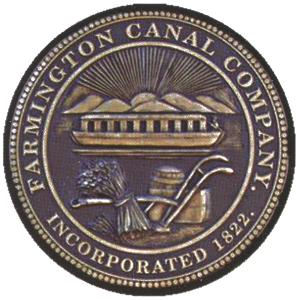
The canal’s southern terminus and primary financial anchor was in New Haven. As early as 1820 a plan had been developed to divert water from the Farmington River to New Haven’s harbor via Southington and the Quinnipiac River. Spurred on by the success of canals in England and New York, a meeting was held on December 10, 1821 at the County Hotel to consider the construction of a canal. The meeting established a committee of prominent residents to estimate costs and hire surveyors. The “President and Directors of the Farmington Canal” was officially chartered in May 1822. New Haven’s commitment was formally cemented on January 2, 1829, when the city subscribed $100,000 to the company’s stock. This municipal investment was justified not only as a commercial venture but also for its civic benefits, which included providing an abundant supply of water for fighting fires and cleansing the “Creek Route” that the canal followed through the city.
The canal’s infrastructure fundamentally altered the landscape of New Haven. Its route terminated in the New Haven harbor at a large, newly constructed Harbor Basin. This basin was an engineering project in itself, formed by a massive pier built to connect Tomlinson’s wharf with the Long Wharf. By October 1830, this pier “Basin Wharf” was nearly complete and its tide gates were hung. Initially started by Henry Cleveland of New York, it was completed by William Lanson, a local contractor and leader of New Haven’s Black community. Lanson was also responsible for the extension of Long Wharf.
The canal’s path through the city, known as the “Creek Route,” necessitated the construction of numerous bridges; bids were sought in January 1827 for fourteen bridges within the city at locations including Chapel, State, and Orange streets. The route also featured eight of the canal’s 28 locks, with five lock houses built in New Haven in 1829. One such location, Lock 28, became a notable site where resident George Rowland established his “City Mill,” which was powered by the canal’s water.
Several prominent New Haven figures were instrumental in the canal’s development and operation. James Hillhouse, a distinguished lawyer, served as the first president of the Farmington Canal Company and was a tireless promoter of the project until his death in 1832. “Commodore” George Rowland constructed the first canal packet boat, the New England, launching it in New Haven in April 1828. In later years, the enterprise was championed and ultimately saved by Joseph Earl Sheffield, who was elected a director in 1841 and president in 1843. It was Sheffield who, along with engineer Henry Farnam, famously hired 500 men to repair thirty different breaches after a devastating flood in October 1843, reopening the canal in just one month.
The operational timeline of the canal is marked by key events centered in New Haven. The first water from the canal network reached the New Haven harbor on July 1, 1828, an event celebrated as the “Meeting of the Waters”. Just two weeks later the New England departed from Hillhouse’s Basin on its way to Farmington. By July 1829, the canal was fully operational from New Haven to Simsbury, and by December of that year the route was open to Westfield, Massachusetts. The canal’s full completion to Northampton was celebrated on July 29, 1835. Daily packet boat service between New Haven and Northampton began in August 1835, advertising a 26-hour trip with meals included.
By 1835 the canal company was bankrupt with a loss of over $1 million in share value. In addition to numerous individual investors, many contractors had been paid in part by shares in the company. In February 1836, the shareholders met in New Haven to approve reorganization as the New Haven and Northampton Company with a capital infusion of $300,000. After assuming debt of the previous company only $135,000 remained for repairs.
The city’s financial support, critical to the canal’s survival, began to wane; after approving a loan of credit in 1839 the city voted against further bond sales in April 1840. Passenger service was withdrawn by October 1839 for lack of patronage. The canal’s fate was sealed under the leadership of Sheffield, who repurchased a controlling interest in 1846 and successfully petitioned to have the company’s charter amended to convert the canal into a railroad. The canal operated for its last full season in the autumn of 1847, as work had already begun on the railroad that would soon be built on its towpath.